
Credit for Prior Learning and the Accreditation Myth That Won’t Go Away
At the Center for Academic Innovation (CAI), much of our work with colleges and universities centers on a deceptively simple question: How do institutions responsibly recognize college-level learning that occurs outside traditional academic pathways? That question sits at the heart of Credit for Prior Learning (CPL) and it is also where one of the most persistent accreditation myths continues to surface.
In recent weeks, Southern Association of Colleges and Schools Commission on Colleges (SACSCOC) President Stephen L. Pruitt launched Law or Lore, a timely and refreshingly candid blog series designed to separate accreditation fact from long-standing fiction. One of the early posts focused on CPL and continuing education addresses a set of assumptions we encounter almost weekly in our work with institutions.
Questions like these still echo across campuses:
Can we award credit for learning that originated in continuing education?
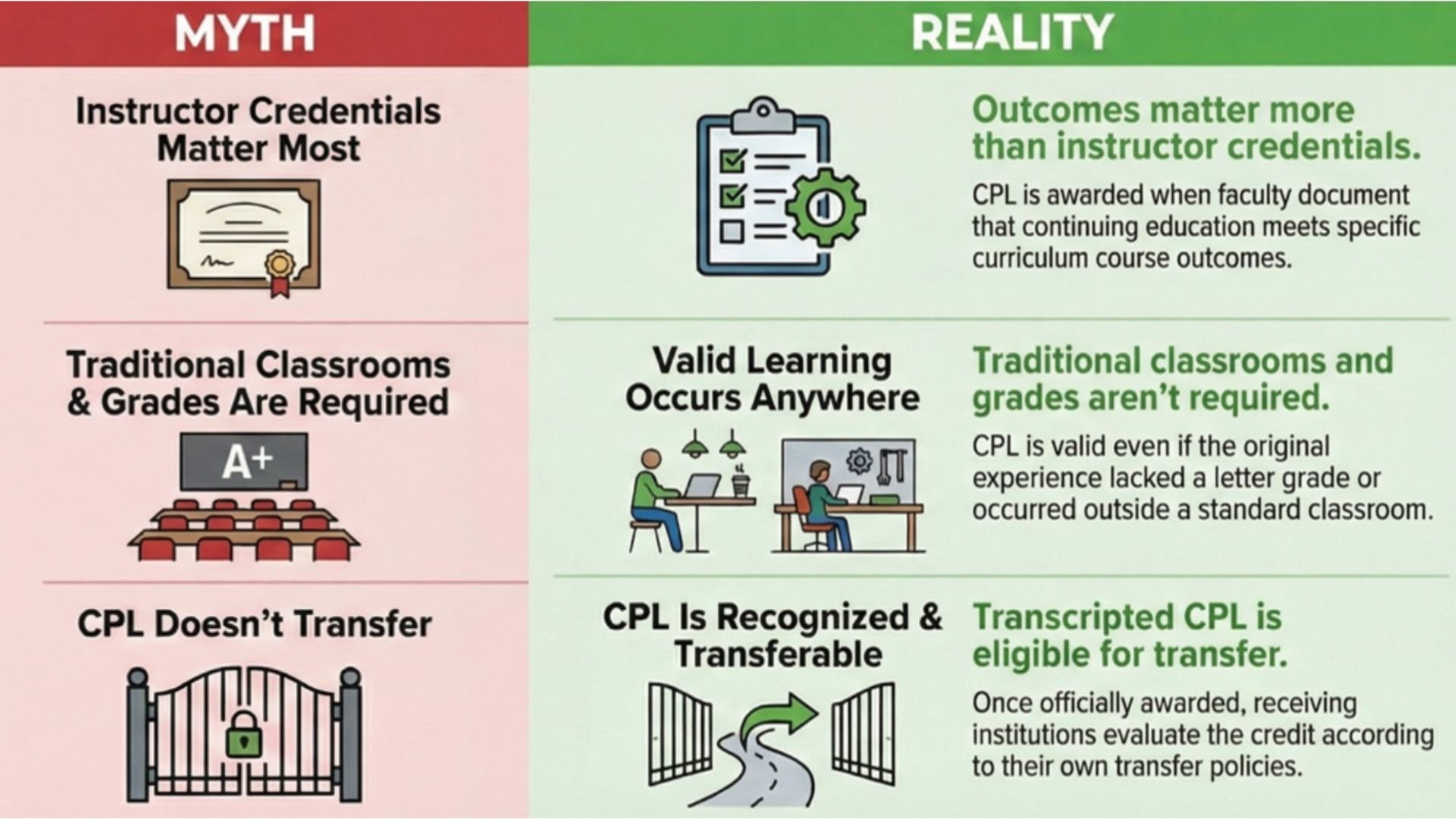
What if the instructor wasn’t credentialed like curriculum faculty?
Does that make the learning invalid or nontransferable?
These questions feel reasonable. They are often asked in good faith. But too often, the answers institutions rely on are based on myth, not law.
Accreditation Is Built on Principles, Not Perceptions
Let’s take the example of SACSCOC to answer these questions. SACSCOC accreditation, like all formerly recognized regional accreditation, is grounded in principles, not preferences or inherited assumptions. Yet over time, institutional habits can calcify into “rules” that no longer reflect policy or intent. The idea that learning must originate in a credit-bearing classroom taught by credentialed faculty in order to ever count for credit is one such assumption. It feels compliant. But it is not what SACSCOC requires.
The SACSCOC Principles of Accreditation do not prohibit awarding curriculum credit for learning that originated in continuing education. What they require for the awarding of any credit is something more precise and more powerful: sound academic judgment, exercised and documented by qualified faculty. Under SACSCOC Standard 10.7, institutions must maintain and follow policies that ensure the "integrity, consistency, and rigor" of credit awarded. Nowhere do the Principles restrict CPL based on the origin of learning.
Instead, the emphasis is on the evaluation process based on the Principles of Accreditation The accompanying SACSCOC Resource Manual notes that:
When undergraduate and graduate courses are offered through nontraditional delivery, the institution awards credit compatible with sound academic practice in the field. A sound academic practice typically involves faculty participation in the evaluation of credit.
In practice, that means an institution may award credit for prior learning from continuing education when: credentialed curriculum faculty evaluate the learning and make the credit determination..
Further, under SACSCOC Standard 10.8, institutions must publish their policies for “evaluating, awarding, and accepting credit not originating from the institution”, with the Resource Manual clarifying that good practices include:
….awarding credit for experiential learning, professional certifications, and conversion of noncredit activities to credit based on well-documented activities and experiences at the appropriate educational level and evaluated based on clearly developed outcomes for the institution’s own courses for which credit is awarded. (Italics added.)
Critically, the credentials of the original continuing education instructor are not determinative. Even when those credentials are unknown, or would not meet curriculum faculty standards, credit may still be awarded if qualified faculty verify that the student has met the expected outcomes with appropriate rigor. This distinction matters.
How Myth Took Root and Why It Persists
So where does the confusion come from? In our experience, institutions often conflate two distinct responsibilities:
Who is qualified to teach a credit-bearing course
Who is qualified to evaluate prior learning for credit
These are not interchangeable roles. The first governs instructional assignments. The second governs academic evaluation. Yet, many colleges assume that if a continuing education instructor does not meet curriculum faculty credentialing standards, then no learning from that context can ever count. Over time, that assumption becomes an institutional myth, and when that myth is repeated year after year, it begins to feel like policy. CPL, however, is not about the instructor. It is about the student’s demonstrated learning. Compliance resides in the faculty-driven evaluation process, not in retroactively credentialing the learning environment.
When institutions mistake myth for reality, the cost is not abstract, it is borne by students.
Why This Matters for Retention, Belonging, and Innovation
Too often, adult learners, especially working adults, veterans, and first-generation students, are asked to repeat learning they have already mastered. Not because the learning lacks quality, but because institutions hesitate to challenge long-standing assumptions. Myths like the ones discussed here, , when left unexamined, become structural barriers to an institution’s ability to support student learning.
When faculty validate learning using clear criteria, appropriate evidence, and documented academic judgment, CPL is not a shortcut. It is a legitimate, faculty-owned academic practice, which is fully aligned with accreditor expectations and with the broader mission of expanding access and opportunity. The standards of accreditors like SACSCOC are not designed to protect silos between continuing education and curriculum. They are designed to ensure rigor, consistency, and trust. When institutions honor that intent, CPL becomes a powerful tool for equity, efficiency, and student success.
So, the next time someone says, “We can’t award credit because it started in continuing education,” you might pause and investigate: Is that reality… or myth?
About the Authors
Matt Bergman is the Founder and President of the Center for Academic Innovation (CAI). He is a nationally recognized leader in Credit for Prior Learning (CPL), adult student success, and degree completion innovation. Dr. Bergman serves as Partner Faculty at the University of Louisville and previously served as a Senior Fellow with Kentucky’s Council on Postsecondary Education, where he helped lead statewide efforts to scale CPL and advance adult learner policy and practice. His work focuses on aligning education, work, and the adult learner journey through institutional strategy and employer partnerships. An award-winning educator and co-author of Unfinished Business: Compelling Stories of Adult Student Persistence, he is a frequent keynote speaker and advisor to colleges, universities, systems, and workforce partners across the country.
Becky Klein-Collins is CAI’s Senior Partner for Research and Adult Learner Success. She is nationally-known for more than fifteen years of research published on the impact of CPL on adult student outcomes, including serving as co-PI and lead author of The PLA Boost: Results from a 72-Institution Targeted Study of Prior Learning Assessment and Adult Student Outcomes (2020) as well as other CPL studies on institutional policy and practice, student perspectives, and accreditor policies. She has also published extensively on strategies for supporting working adult learners and workers in career transitions. She was the lead author of Never Too Late: The Adult Student’s Guide to College (New Press, 2018).
To learn more about how CAI can help your institutions improve CPL strategies and support adult learners, contact us at centerforacademicinnovation.org