
The Elephant in the Room: Engaging Faculty as Change Agents for Credit for Prior Learning Work
Faculty as Change Agents: Advancing Credit for Prior Learning to Support Adult Learner Success
Across the United States, institutional implementation of Credit for Prior Learning (CPL) continues to expand. Although leaders widely recognize that faculty play a critical role—as disciplinary experts who design curriculum and assess learning—engaging them meaningfully in this work remains challenging. These challenges are both structural and cultural. In this article, we argue for a combined Appreciative Inquiry and Human-Centered Design (HCD) approach that positions faculty as partners in change and offer practical steps leaders can take to invite faculty into this work.
The Need for Credit for Prior Learning (CPL)
As institutions face mounting pressure to grow enrollment and improve student outcomes, many are turning their attention to adult learners—particularly those with “some college, no credential” (SCNC). According to a 2025 study from the Lumina Foundation, the SCNC population stood at 43.1 million adults at the start of the 2023-2024 academic year. CPL is an essential strategy in this context. It provides a structured pathway for recognizing learning acquired outside traditional classrooms and enabling students to translate prior knowledge and experience into academic credit. When implemented effectively, CPL can accelerate time to degree, reduce costs, and increase enrollment among working adults, veterans, and other learners.
The benefits of CPL are well documented. Students who earn CPL credit tend to accumulate more credits, persist at higher rates, and complete their degrees more often than peers who do not.
Engaging Faculty in CPL
While much of the CPL conversation has focused on policy and program design, faculty engagement is a decisive factor in institutional success. Leaders understand its importance—but also its difficulty. CPL expansion is occurring in a context of initiative fatigue, leadership turnover, and heightened scrutiny of academic work, all of which contribute to faculty skepticism toward institutionally driven change.
Traditional change strategies often reinforce this challenge. Many institutions still rely on presenting data and communicating urgency, assuming awareness will generate commitment. In practice, faculty are not consistently brought into meaningful problem definition or given genuine influence over solutions, which can leave them positioned as audiences for change rather than as partners in the work.
The result is uneven engagement. While some faculty participate enthusiastically, others comply superficially, and many disengage altogether. These behaviors are often rational responses to systems that provide limited voice, unclear incentives, and little continuity—ultimately undermining CPL and other student success efforts.
Appreciative Inquiry and Human-Centered Design as an Alternative Framework
Successfully engaging faculty requires approaches that are both inclusive and generative. Appreciative Inquiry and Human-Centered Design offer complementary pathways.
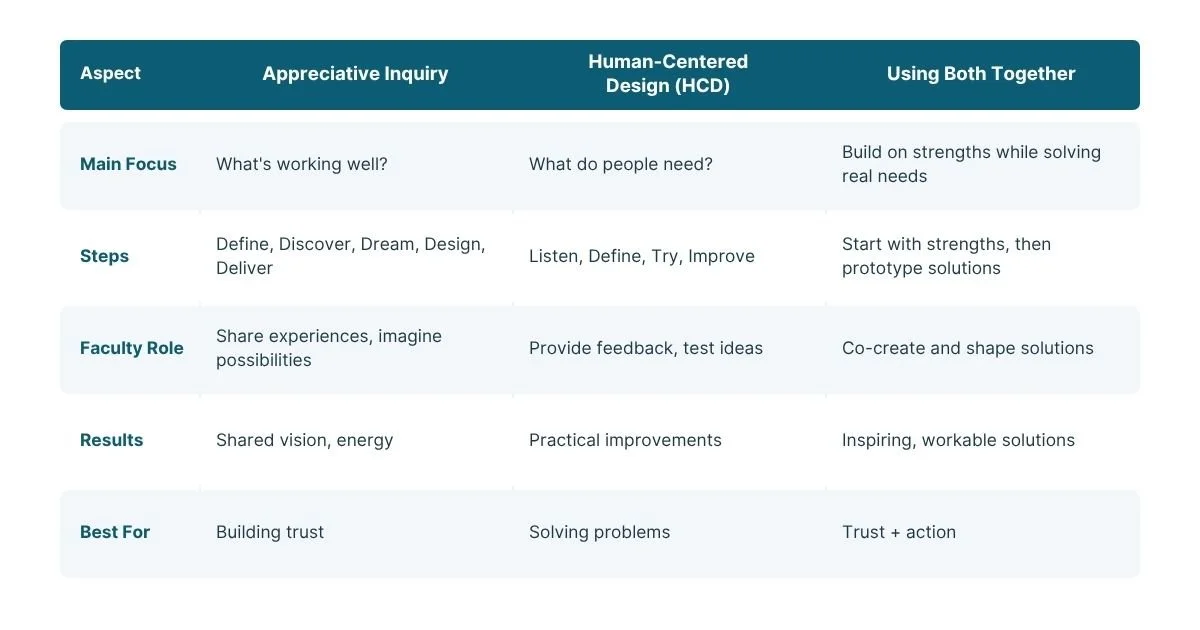
Appreciative Inquiry is a strengths-based approach that invites faculty to reflect on what is already working and build on those successes. Human-Centered Design (HCD) assumes those closest to the work—faculty included—bring essential insights into student challenges and potential solutions.
Together, these approaches position faculty as co-creators. Appreciative Inquiry surfaces strengths and shared purpose, while HCD translates those insights into practical, testable solutions. This combination builds trust, increases agency, and supports sustainable change.
Appreciative Inquiry and Human-Centered Design: Distinctions and Complementarity
CPL: A Case Study in Faculty Engagement Challenges
CPL illustrates both the promise and complexity of faculty engagement. Faculty, as disciplinary experts, are central to evaluating prior learning and determining whether it meets academic standards. Their early and sustained involvement is essential for these programs to grow and thrive.
However, institutional structures can complicate this work. CPL is often housed outside Academic Affairs—in registrars’ offices or workforce units—which can distance it from academic programs and limit faculty awareness and participation. More importantly, such placement may communicate to faculty that CPL operates separately from and outside of the core academic enterprise.
Concerns about academic rigor are both real and necessary. Faculty must ensure that CPL assessments reflect college-level learning aligned with disciplinary standards. Without clear policies, professional development, and meaningful engagement opportunities, skepticism persists.
Strategies for Building Faculty Support and Engagement
The strategies below adapt Appreciative Inquiry’s focus on building from existing strengths and HCD’s emphasis on the needs and expertise of faculty.
Recognize CPL as Values-Based WorkAcknowledge faculty commitment to students and disciplinary integrity. Create opportunities for faculty to connect CPL to their own values and institutional mission.
Engage Faculty as Co-CreatorsInvolve faculty early and consistently in designing CPL processes. Provide time, resources, and collaborative structures to support faculty involvement.
Identify and Scale What’s WorkingSurface existing successful practices and expand them across departments.
Shift from Compliance to Institutional Change Capacity BuildingFrame CPL as an opportunity for experimentation and learning, supported by training and iteration.
Build Continuous Feedback LoopsCreate mechanisms for ongoing faculty input and then visibly act on that feedback.
Use Data to Reinforce ImpactShare outcomes and student success stories to demonstrate how CPL supports what faculty care about - student well-being.
Offer Recognition and IncentivesProvide stipends, course releases, or recognition in promotion and tenure processes.
Address Organizational Structure and CultureBridge gaps between administrative and academic units and build trust through relationships.
Design for EquityEnsure CPL processes are inclusive, equitable, and responsive to diverse student experiences and faculty and staff needs.
Conclusion
As higher education continues to evolve, the imperative to serve adult learners will only intensify. CPL is not a panacea, but it is a powerful tool—one that depends on faculty expertise, judgment, and commitment.
CPL also offers a broader lesson in the change strategies necessary to move student success work. It demonstrates how institutions can engage faculty more effectively by centering collaboration, respect for expertise, and shared ownership. Approaches grounded in Appreciative Inquiry and Human-Centered Design move institutions beyond compliance and toward trust, creativity, and sustained commitment - elements institutions need to move beyond siloed initiatives to student success-focused cultures.
This model of faculty engagement can inform a wide range of student success initiatives. At its core there is a simple but critical insight: faculty are not barriers to change—they are essential to it. Without their support and active participation, even well-designed initiatives will struggle. With it, institutions can achieve lasting, transformative changes that better serve the needs of students and faculty.
Key Takeaways
Faculty engagement is essential to sustainable change efforts
Appreciative Inquiry and HCD foster deeper investment and ownership
Structure, policy, and professional development shape engagement
Recognition and incentives build trust and momentum
Data and storytelling reinforce impact
Equity-centered design is critical to success
Faculty are central—not peripheral—to meaningful institutional change
Author Bios:
Suzanne Wilson Summers is a Fellow with the Gardner Institute where she co-leads the Academic Leadership Community of Practice. She is also the founder of Collective Impact by Design, where she partners with colleges and universities to advance student success through human-centered approaches to change.
Stacy Townsley-Kestin is Senior Partner for Systems Innovation at the Center for Academic Innovation. She works with institutions and agencies to support the discovery and implementation of systems-level solutions for people who most need access to training and education, leading to greater economic mobility.